
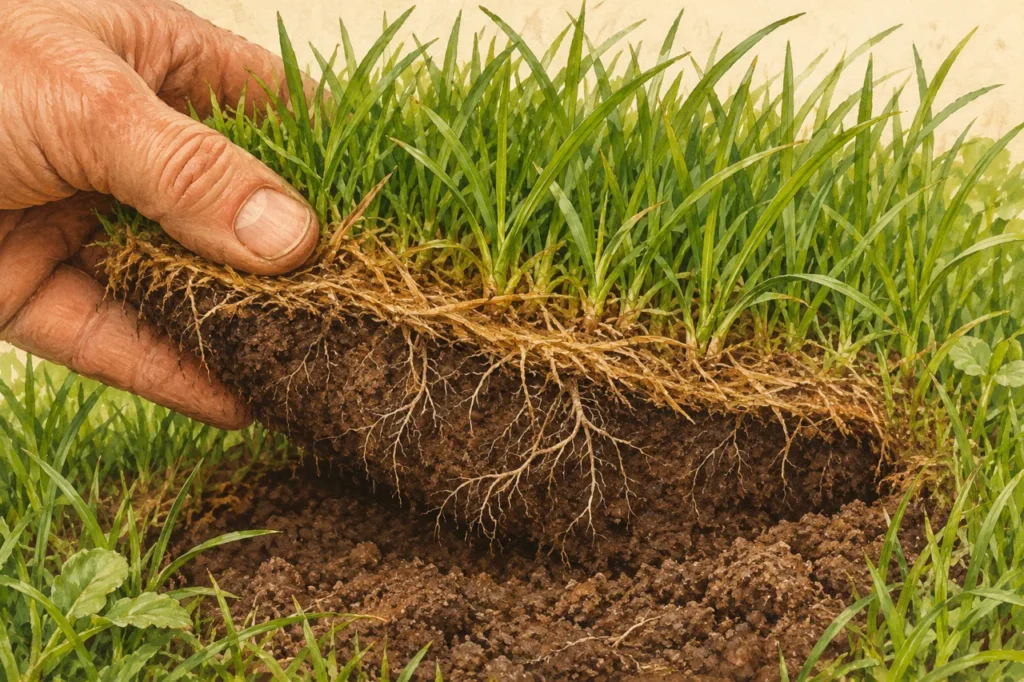
Lawn thatch is a dense layer of living and dead material between green grass blades and the soil. It is easy to mistake loose clippings on the surface for thatch. Before hiring a crew to power rake a Mankato lawn, look at a small cross section of turf.
Inspect the layer below the blades
Lift a small wedge with a hand tool in a safe spot away from buried lines. Look sideways at the profile. You should see green leaves above, soil below and possibly a fibrous brown layer between them. Gently measure that layer without counting the soil.
Repeat in several places, including one that feels springy underfoot. A loose pile of fresh clippings sits above the grass and usually breaks down quickly. The tighter layer under the blades has a different structure and calls for a different response.
Choose the job the lawn needs
A thin layer can be normal. University of Minnesota Extension uses roughly half an inch as a point to examine management more closely. Heavy buildup may interfere with water movement and rooting. A surface rake full of brown material alone doesn’t tell you how thick the layer is.
Dethatching removes excess material. Core aeration primarily addresses compacted soil and can also help manage buildup. A lawn may need either operation, both on a sensible schedule or neither one. Ask which observation supports the proposed treatment.
Allow time for recovery
Mechanical removal disturbs the turf. Schedule it when grass can recover in active growth, and discuss how debris will be collected. If the season is already too far along, document the depth now and plan the work for a better window.
See the University’s guide to controlling lawn thatch. For lawn maintenance advice, share a close photo of the turf profile and its measurement. That is more useful than a picture of clippings on a driveway.